PMDD vs PMS: how they differ and how to tell
PMS and PMDD share many symptoms. ACOG calls PMDD “a severe type of PMS.”[2] What the DSM-5 adds for PMDD is a stricter checklist: at least five symptoms, at least one of them a mood symptom, in the week before your period, with real trouble in daily life.[1] Only a clinician can say which one fits you. A daily record is what they ask for.
PMS and PMDD side by side
| Question | PMS | PMDD |
|---|---|---|
| What is it? | Physical or mood changes in the days before a period that repeat month after month and affect normal life.[2] | A severe type of PMS that affects a small percentage of women, according to ACOG.[2] The DSM-5 defines it with a stricter checklist.[1] |
| How many symptoms? | Carlini and colleagues say the common clinical definition of PMS focuses on impairment and does not specify the number or type of symptoms.[1] | At least five, and at least one must be a mood symptom: mood swings, irritability or anger, depressed mood, or anxiety.[1] |
| When do symptoms occur? | ACOG: present in the 5 days before a period, for at least three cycles in a row, and ending within 4 days after the period starts.[2] | DSM-5: present in the final week before the period, starting to improve within a few days after it starts, and minimal or gone the week after. This holds in most cycles of the past year.[1] |
| How much does it disrupt life? | Interferes with some normal activities.[2] | Clinically significant distress, or trouble at work, school, in usual social activities or in relationships.[1] |
| How common is it? | Carlini and colleagues cite 13% to 18% for PMS with clinically significant distress.[1] | The DSM-5 reports a 1.8% to 5.8% 12-month prevalence among menstruating women in the United States.[1] |
| How is it confirmed? | An ob-gyn confirms the pattern. ACOG suggests rating symptoms every day for at least 2 to 3 months and noting your period dates.[2] | The timing is confirmed by daily ratings over at least two symptomatic cycles. A provisional diagnosis can come first.[1] |
| What treatment do the sources name? | ACOG: mild to moderate symptoms often can be relieved by changes in lifestyle or diet. More severe cases may need medication.[2] | ACOG: SSRIs can help treat PMDD in some women.[2] Carlini and colleagues find the highest-quality evidence for SSRIs and combined oral contraceptives.[1] |
These two columns use different sources on purpose. ACOG’s FAQ describes PMS in plain terms. The DSM-5 checklist, as Carlini and colleagues reproduce it, is the one place that sets a symptom count for PMDD.[1]
Is PMDD just bad PMS?
The sources frame it a little differently. ACOG calls PMDD a severe type of PMS.[2] The NHS says PMDD symptoms are similar to PMS but much more intense, with a much greater effect on everyday life.[3] The International Association for Premenstrual Disorders (IAPMD) describes PMDD as “a cyclical hormone-based mood disorder.”[4]
Carlini and colleagues, describing the International Society for the Study of Premenstrual Disorders (ISPMD) framework, treat both PMS and PMDD as core premenstrual disorders.[1] Whether you call it a spectrum or two conditions, the practical question is the same: how many symptoms, when they start and stop, and how much they get in the way.
Symptoms that show up in both
Irritability or anger, low mood, anxiety, trouble concentrating, trouble sleeping, breast tenderness and bloating are named in both ACOG’s PMS list and the DSM-5 PMDD list.[1][2] That is Prova’s reading of the two lists, not a claim from either source. It is also why one symptom, even a strong one, cannot tell the two apart. Our PMDD rage guide goes through this for anger.
Other things that can look like PMS or PMDD
ACOG names depression, anxiety, perimenopause, chronic fatigue syndrome, irritable bowel syndrome and thyroid disease as conditions that can mimic or overlap with PMS. It says about half of women seeking treatment for PMS have depression or an anxiety disorder, and that depression symptoms are often present all month.[2]
The DSM-5 criteria say PMDD is not merely a flare of another disorder such as major depression or panic disorder, although it can exist alongside them. They also say the symptoms must not be due to a substance, a medicine or another medical condition, with hyperthyroidism given as an example.[1] If your cycle is changing with age, read PMDD and perimenopause.
How to find out which one you may have
Prova’s suggestion: keep a dated daily record for at least two cycles. ACOG suggests 2 to 3 months for PMS, and the DSM-5 asks for two symptomatic cycles for PMDD.[1][2] This list is a way to organise notes. It is not a test and not a diagnosis.
- The date, the first day of each period, and the day of your cycle.
- Each symptom, rated the same way every day. Include days with none.
- Whether symptoms ease within a few days after your period starts, and how you feel the week after.
- What each symptom got in the way of: work, school, plans, people close to you.
Then compare your record with the table above: how many symptoms, whether one of them is a mood symptom, when they start and stop, and how much they disrupt your life. Take the record to a clinician and ask what it shows. Our guide to how PMDD is diagnosed explains the process.
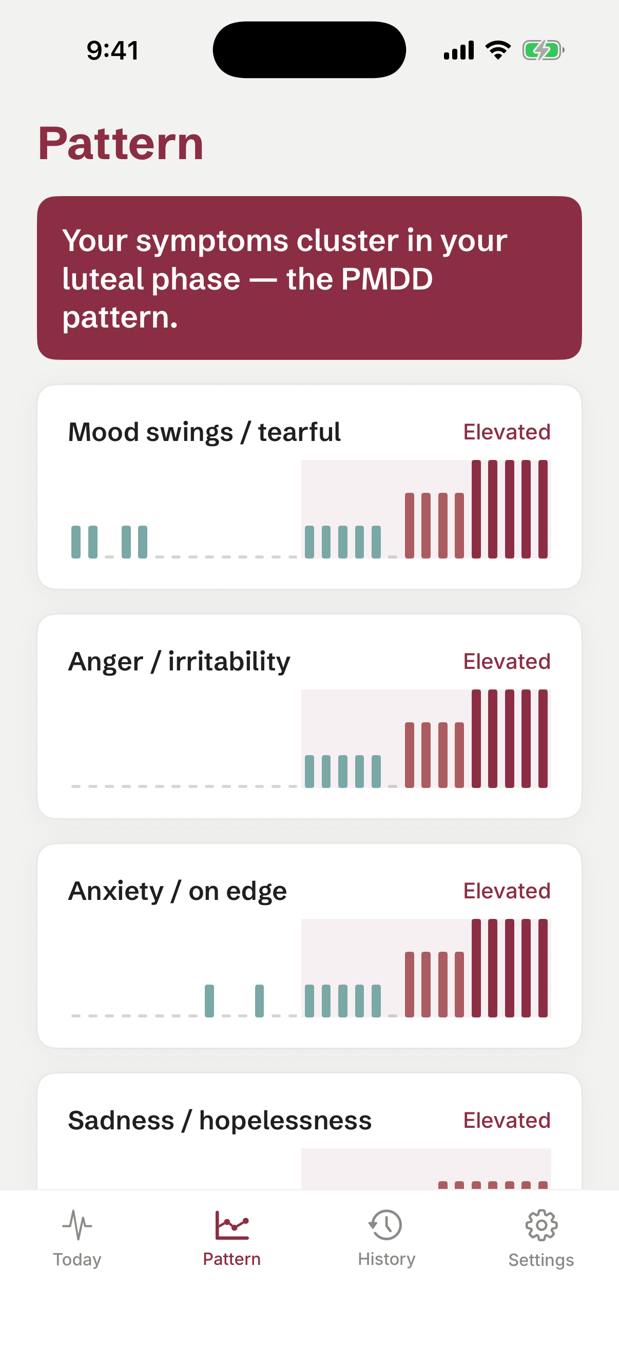
Prova is a PMDD symptom tracker for iPhone. It logs symptoms every day and shows how they cluster by cycle phase. Daily logging and the pattern view are free. Prova does not diagnose PMDD.
Print a daily PMDD symptom tracker or get Prova for iPhone on the App Store.
What to bring to a clinician visit
- Your daily record, with the dates you started bleeding.
- A question: “Does my pattern look like PMS, PMDD, or something else?”
- A question: “Could depression, anxiety, a thyroid problem or perimenopause explain some of this?” ACOG lists all four as conditions that can overlap.[2]
- A question: “What treatment fits me?” Do not start, stop or change a medicine based on this page.
You can also try the PMDD symptom self-check or estimate luteal phase dates with the calculator. Use them to prepare questions, not to decide a diagnosis yourself.
If you are thinking about suicide or are in crisis, call or text 988 (the US Suicide & Crisis Lifeline) right now. If anyone is in immediate danger, call 911.
Sources
- Carlini SV and colleagues. Management of Premenstrual Dysphoric Disorder: A Scoping Review. 2022. Reproduces the DSM-5 criteria and reviews treatment evidence. https://pmc.ncbi.nlm.nih.gov/articles/PMC9790166/
- American College of Obstetricians and Gynecologists. Premenstrual Syndrome (PMS), FAQ057. Last updated May 2021, last reviewed November 2025. https://www.acog.org/womens-health/faqs/premenstrual-syndrome
- NHS. PMS (premenstrual syndrome), including the section on premenstrual dysphoric disorder. Page last reviewed 18 June 2024. https://www.nhs.uk/conditions/pre-menstrual-syndrome/
- International Association for Premenstrual Disorders. What is PMDD? https://iapmd.org/about-pmdd