PMDD and ADHD: How do they overlap?
PMDD and ADHD were linked in a 2024 study by Lin and colleagues in the Journal of Women's Health, which found higher inattention across the cycle in women with PMDD [1]. The findings do not establish that either condition causes the other. Track attention, memory, impulsivity and period dates through the month, then discuss the record with a clinician.
What does research say about PMDD and ADHD?
The study Comorbid Attention Deficit Hyperactivity Disorder in Women with Premenstrual Dysphoric Disorder (Lin and colleagues, Journal of Women's Health, September 2024) [1] enrolled 58 women with PMDD and 50 controls. Researchers assessed attention and impulsivity at different points in the menstrual cycle [1].
They found an association between ADHD and PMDD. Women with PMDD had higher inattention across the cycle. Within the PMDD group, those with ADHD scored higher for everyday memory problems and on an impulsivity measure than those without ADHD. This was seen during the pre-ovulatory and mid-luteal phases [1].
These are comparisons between groups. They do not tell you which condition explains your own symptoms.
Do ADHD symptoms get worse before a period?
The answer needs care. The PubMed study found a greater rise in everyday memory problems and trouble keeping attention in women with PMDD than in controls, between the earlier and later cycle phases it measured. A similar rise was seen in the PMDD subgroup without ADHD [1].
That does not establish that ADHD symptoms themselves get worse before a period. A result for the whole PMDD group cannot simply be treated as a result for ADHD.
The impulsivity finding also had a limit. PMDD was linked to increased impulsivity in the late-luteal phase, but the authors said it was not linked to a persistent elevation in impulsivity [1].
Record what happens through the month, including days that feel easier. Leave room for your record to look different from a study's group result.
What the evidence cannot tell us
The evidence here is limited. Only the study's summary (abstract) is publicly available here, not the full paper. It describes the participants, rating tools and findings, but gives no treatment instructions or way for a reader to diagnose themselves.
Queen Mary University of London (2025) also published a university news release about research using online questionnaire responses from women in the UK [2]. That is a news page, not the study itself. It is background here; this guide does not use its risk figures as clinical evidence.
Neither source gives a basis for ADHD medication advice. If you have questions about a medicine, talk to your prescriber. This guide cannot tell you whether a medicine or dose is right for you.
What to track
Use a daily note to describe the day you actually had. These practical prompts cover the attention, memory and impulsivity areas assessed in the PubMed study [1]. They are not a diagnostic test or a new symptom scale.
- Date and period days. Write the date beside each entry and mark any period bleeding. Keep the timing beside the note.
- Attention. What was hard to stay focused on? Name a task, such as reading a message or finishing an assignment.
- Everyday memory. What did you mean to do, and what did you forget? Describe the event without guessing its cause.
- Impulsivity. Note an action you want to discuss. Describe what happened and its effect, rather than using a label alone.
- Your own comparison. Write down days when these tasks felt easier, too. Use the same questions through the month so you have more than a list of difficult days.
Keep the record brief enough to return to. If you miss an entry, leave a gap instead of filling it with a guess. You can keep extra notes alongside whichever tracker you choose.
Keep attention, memory and impulsivity as separate notes. A single label such as "bad day" will not show which task was difficult. When you review the entries, compare the same questions across dates. Write down what you still want to ask, rather than trying to name the cause yourself.
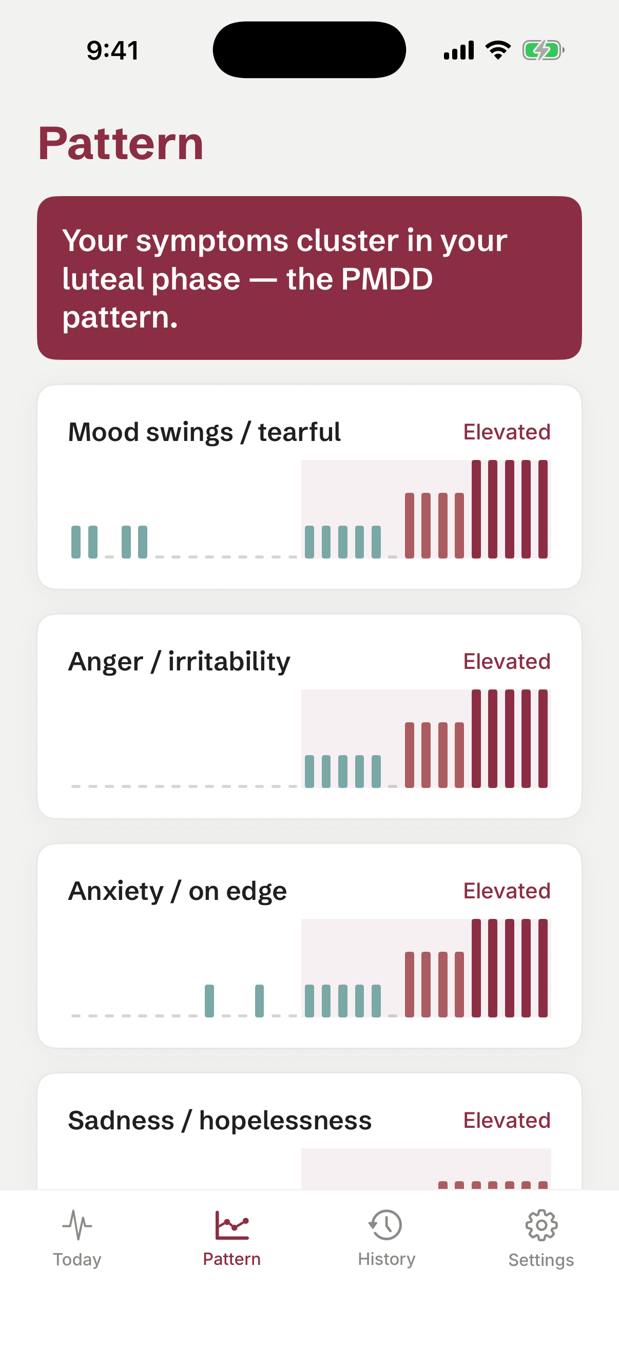
Prova is a PMDD symptom tracker for iPhone. Daily logging and the pattern view are free.
Print a daily PMDD symptom tracker, or get Prova, a PMDD symptom tracker for iPhone.
What to bring to an appointment
Bring the notes and a short list of questions. Ask how your attention, memory and impulsivity should be assessed alongside your PMDD concerns. The PubMed authors recommend assessing ADHD when looking at inattention and impulsivity in women with PMDD [1].
For related reading, learn how PMDD is diagnosed. You can also open the PMDD self-check and estimate luteal phase dates with the calculator. Use them as prompts for discussion with a clinician.
If you are thinking about suicide or are in crisis, call or text 988 (the US Suicide & Crisis Lifeline) right now.
Sources
- Comorbid Attention Deficit Hyperactivity Disorder in Women with Premenstrual Dysphoric Disorder - PubMed. Study abstract. Lin PC, Long CY, Ko CH, Yen JY. Journal of Women's Health, September 2024. DOI 10.1089/jwh.2023.0907 (from the PubMed record's citation tags). https://pubmed.ncbi.nlm.nih.gov/38836765/
- ADHD link to severe premenstrual disorder uncovered in women - Queen Mary University of London. University news release, 23 June 2025. Background on the reported research method only. https://www.qmul.ac.uk/news/latest-news/2025/science-and-engineering/se/adhd-link-to-severe-premenstrual-disorder-uncovered-in-women.html