PMDD and birth control: what the evidence says
Pills containing drospirenone and ethinylestradiol (EE) may improve premenstrual symptoms that interfere with daily life in women with PMDD, according to the 2023 Cochrane review.[1] Effects may be small to moderate, and placebo also had a significant effect.[1] This guide summarises the sources below for a talk with your prescriber.
Which birth control pill has PMDD evidence?
The Yaz label (2023 revision) names its PMDD use for “females of reproductive potential who choose to use an oral contraceptive as their method of contraception.”[2] In plain terms, this use is tied to also wanting a pill for birth control.
The 2023 review covers combined pills containing drospirenone and EE.[1] These names identify the evidence discussed here. They are not instructions to take a medicine.
The label also says Yaz has not been evaluated for treating premenstrual syndrome (PMS).[2] Keep that distinction in mind when reading a treatment claim.
What did the birth control trials find?
The 2023 review included five randomised controlled trials, with 858 women analysed. Most had PMDD.[1]
The reviewers say these pills may improve premenstrual symptoms that cause functional impairment, meaning difficulty with daily life.[1] Effects may be small to moderate. The placebo also had a significant effect.[1] These findings do not promise a personal result.
How strong is the PMDD evidence?
The evidence quality ranged from very low to moderate. The reviewers describe problems with how study methods were reported, and serious differences and uncertainty in results.[1]
They do not know whether the pills work after three cycles, help women with less severe symptoms, or work better than other combined pills.[1] They found no studies comparing drospirenone pills with other combined pills.[1]
The Yaz label also says PMDD effectiveness beyond three menstrual cycles has not been evaluated.[2] Ask your prescriber how follow-up will be planned.
How the 2023 review differs from the 2012 one
Both abstracts report five trials: 2012 gives 1,920 women in total; 2023 gives 858 women analysed.[5,1] Those labels differ, and the abstracts alone do not explain the smaller analysed count.
The 2023 abstract rates evidence very low to moderate. The 2012 abstract calls for higher-quality trials but gives no matching overall quality range.[1,5] The two summaries do not show that the evidence got weaker.
The 2012 results say two PMDD trials “showed less severe premenstrual symptoms”; 2023 uses “may improve” and says effects “may be small to moderate”.[5,1] The 2012 conclusion also used cautious wording: “may help”.[5] Placebo wording changes from “large” to “significant”.[5,1] The 2012 version is kept only as history.
Can birth control make mood worse?
The 2023 reviewers were uncertain about effects on premenstrual mood symptoms measured with validated tools that were not developed to assess premenstrual symptoms.[1]
The Yaz patient information (2023 revision) lists depression as a possible side effect, especially in people who have had depression before.[2] Its PMDD indication does not erase that warning.
The 2023 review says drospirenone plus EE may increase withdrawals from trials because of side effects and may cause more side effects than placebo. It probably leads to more breast pain, and may lead to more nausea, bleeding between periods, and menstrual disorders.[1]
Talk with your prescriber about mood changes or side effects that concern you. Ask how to reach them between visits. This guide cannot tell you whether to start, stop, or change a medicine.
If you are thinking about suicide or are in crisis, call or text 988 (the US Suicide & Crisis Lifeline) right now.
What to ask your prescriber
Bring the exact name of any medicine you use and a short list of questions:
- Does the evidence we are discussing match this pill and my diagnosis?
- Am I also looking for contraception, or is PMDD treatment my main aim?
- Which benefits and risks should we discuss?
- When will we review my symptom record?
Birth control is not the only treatment named in these sources. The 2022 scoping review by Carlini and colleagues also covers medicines called selective serotonin reuptake inhibitors (SSRIs).[3] Ask your prescriber to explain the options in the context of your needs.
For background, read how PMDD is diagnosed, or use the PMDD self-check to review your symptoms.
What to track
ACOG's PMS FAQ (updated 2021, reviewed 2025) recommends writing down and rating symptoms each day, along with period dates.[4] This is guidance about PMS. For PMDD, Carlini and colleagues (2022) describe daily ratings recorded as symptoms happen as the standard for diagnosis.[3]
Note mood symptoms, physical symptoms, and how much they interfere with work, school, or relationships. The Yaz label (2023 revision) describes these as part of PMDD.[2] Bring your notes to your prescriber to discuss the pattern.
For a calendar aid, estimate the luteal phase with the calculator.
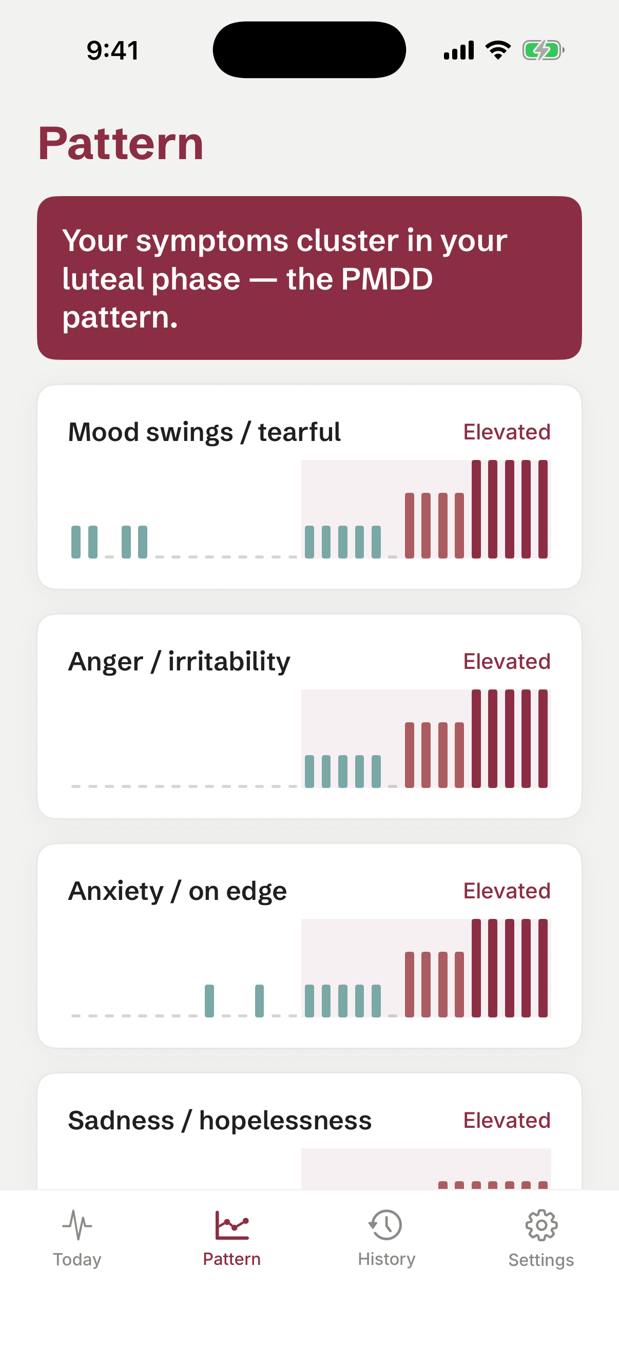
Prova is a PMDD symptom tracker for iPhone. Daily logging and the pattern view are free.
Print a daily PMDD symptom tracker, or get Prova, the PMDD symptom tracker for iPhone, on the App Store.
If you are thinking about suicide or are in crisis, call or text 988 (the US Suicide & Crisis Lifeline) right now.
Sources
- Ma S, Song SJ. Cochrane Database of Systematic Reviews, 23 June 2023. Oral contraceptives containing drospirenone for premenstrual syndrome. DOI: 10.1002/14651858.CD006586.pub5. Main review used in this guide. Read the 2023 review abstract.
- DailyMed. YAZ- drospirenone and ethinyl estradiol kit. Prescribing information revised May 2023; DailyMed page updated May 29, 2025. Read the Yaz label.
- Carlini SV and colleagues (2022). Management of Premenstrual Dysphoric Disorder: A Scoping Review. Read the scoping review.
- American College of Obstetricians and Gynecologists (ACOG). Premenstrual Syndrome (PMS). Updated May 2021; last reviewed November 2025. Read ACOG's PMS FAQ.
- Cochrane Database of Systematic Reviews (2012). Oral contraceptives containing drospirenone for premenstrual syndrome. Earlier version, retained only as history for the comparison above. Read the review abstract.