PMDD rage: what research says and what to track
Anger is one of the mood symptoms in the DSM-5 criteria for PMDD. But the criteria say “irritability or anger,” not “rage,” and anger alone is not a diagnosis.[1] What counts is a pattern that repeats across cycles and is confirmed with daily ratings. Prova’s suggestion is to write down what happens and take that record to a clinician.
Is anger a symptom of PMDD?
Yes. The DSM-5 criteria, as Carlini and colleagues (2022) reproduce them, list four mood symptoms. At least one must be present. One of the four reads: “Marked irritability or anger or increased interpersonal conflicts.”[1]
“Rage” is the word many people search for. It does not appear in the criteria as Carlini and colleagues print them.[1] A clinician will ask about anger and irritability, so describe what you feel in your own words and include what happened.
The criteria also require five symptoms in total. The other symptoms can come from a second list, such as trouble concentrating, low energy, or a sense of being overwhelmed or out of control.[1]
Does anger on its own mean PMDD?
No. ACOG’s PMS FAQ lists angry outbursts and irritability among the emotional symptoms of PMS.[2] So anger by itself does not tell PMS and PMDD apart. That is Prova’s reading of the two sources, not a statement from either one.
In the DSM-5 criteria, what points toward PMDD is the whole pattern:[1]
- In most cycles, symptoms start in the final week before your period, begin to improve within a few days after it starts, and are minimal or gone the week after.
- At least five symptoms in all, with at least one of them a mood symptom.
- Real distress, or trouble at work, school, social life or relationships.
- Not just a flare of another condition, such as depression or panic disorder. The criteria allow that PMDD can exist alongside them.
- Confirmed by daily ratings over at least two symptomatic cycles.
That last point is why a daily record matters more than how strong one bad day felt. Read how PMDD is diagnosed.
What have studies found about anger in PMDD?
Akyol and colleagues (2013) compared 50 women who met PMDD criteria with 50 healthy women. They used the State-Trait Anger Scale. The PMDD group scored higher on anger measures.[3] The authors wrote that anger “appears to be an important problem” for women with PMDD and asked for larger studies. This was a small study.
Gröndal and colleagues (2025) followed 27 women who reported high premenstrual irritability and anger. In a crossover design, escitalopram in the luteal phase lowered their self-rated irritability and anger compared with placebo.[4] The authors suggest impulsivity may play a role. It is a very small study, and it does not show that a medicine is right for you.
Dubol and colleagues (2026) ran a randomised, placebo-controlled trial in women with PMDD. Escitalopram taken in the luteal phase reduced PMDD symptoms more than placebo, in particular irritability or anger. Self-rated aggressiveness also fell.[5] When we checked on 1 November 2026, this paper was published online ahead of print.
Read these as research findings about groups of women. They cannot say why you feel angry on a particular day.
What treatments do the reviews name?
Carlini and colleagues (2022) report that the best evidence is for SSRIs and combined oral contraceptives. They say GnRH agonists and surgery have shown benefit in cases that did not respond to other treatment.[1] That review covers PMDD as a whole, not anger alone.
Our PMDD and birth control guide goes through what the Yaz label and reviews say. Talk with your prescriber about what fits you. Do not start, stop or change a medicine based on this page.
What to record about anger
Prova’s suggestion: keep a dated daily record. This list is a way to organise notes. It is not a test and not a diagnosis.
- The date, and which day of your cycle it was (day 1 is the first day of bleeding).
- How strong the anger or irritability felt, on the same scale every day. Include days with none.
- What set it off, in a few plain words. “Nothing I could find” is a fine answer.
- What you did and how long it lasted.
- What it affected: a fight, work, the kids, a message you wish you had not sent.
- How things felt in the first days after your period started.
Write what happened. Do not grade yourself. A clinician needs the pattern, not a verdict on you.
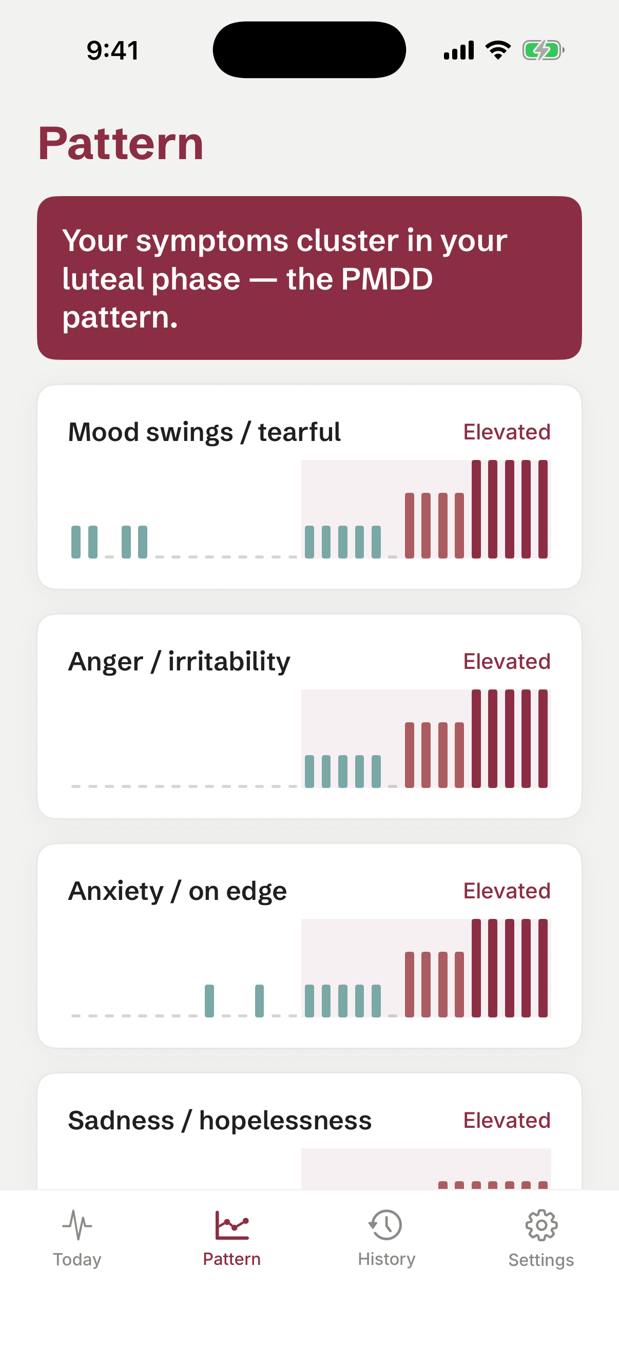
Prova is a PMDD symptom tracker for iPhone. It tracks “Anger / irritability” as its own symptom. Daily logging and the pattern view are free. Prova does not diagnose PMDD.
Print a daily PMDD symptom tracker or get Prova for iPhone on the App Store.
What to bring to a clinician visit
- Your daily record, with the dates you started bleeding.
- A question: “Does my pattern fit the PMDD criteria?”
- A question: “Could another condition explain some of this, or be adding to it?” The criteria say PMDD should not be just a flare of another condition.[1]
- A question: “What treatment options fit me?”
You can also try the PMDD symptom self-check or estimate luteal phase dates with the calculator. Use them to prepare questions, not to decide a diagnosis yourself.
If you are thinking about suicide or are in crisis, call or text 988 (the US Suicide & Crisis Lifeline) right now. If anyone is in immediate danger, call 911.
Sources
- Carlini SV and colleagues. Management of Premenstrual Dysphoric Disorder: A Scoping Review. 2022. Reproduces the DSM-5 criteria and reviews treatment evidence. https://pmc.ncbi.nlm.nih.gov/articles/PMC9790166/
- American College of Obstetricians and Gynecologists. Premenstrual Syndrome (PMS), FAQ057. Last updated May 2021, last reviewed November 2025. https://www.acog.org/womens-health/faqs/premenstrual-syndrome
- Akyol ES, Karakaya Arısoy EÖ, Cayköylü A. Anger in women with premenstrual dysphoric disorder: its relations with premenstrual dysphoric disorder and sociodemographic and clinical variables. Comprehensive Psychiatry, 2013. Comparison of 50 women with PMDD and 50 healthy women. https://pubmed.ncbi.nlm.nih.gov/23759151/
- Gröndal M and colleagues. The effects of intermittent escitalopram treatment on impulsivity and inattention in women with premenstrual irritability and anger. Psychological Medicine, 2025. Crossover study, 27 women. https://pubmed.ncbi.nlm.nih.gov/41054790/
- Dubol M and colleagues. Escitalopram and brain reactivity to aggressive stimuli in premenstrual dysphoric disorder. British Journal of Psychiatry, 2026 (online ahead of print when checked). Randomised placebo-controlled trial. https://pubmed.ncbi.nlm.nih.gov/42515970/