PMDD and perimenopause: when your cycle changes
PMDD may worsen during perimenopause, while cycle length and frequency can also change, according to Sander and colleagues (2024) and Freeman (2002).[1,2] Those findings do not tell you what is causing a change in your own symptoms. Prova's suggestion is to keep a dated daily record and take it to your clinician.
Can PMDD get worse in perimenopause?
Sander and colleagues' 2024 clinical overview in CMAJ says PMDD symptoms may worsen in perimenopause.[1] It describes symptoms linked to changing ovarian hormones during the luteal phase, the time from ovulation to menstruation.
The same overview says symptoms typically ease at menopause when ovulation is absent.[1] That is different from saying they will ease during the transition leading up to it.
“May worsen” is a careful phrase, not a forecast of your experience. Use it as a reason to ask about a change.
Can periods still be regular?
Freeman's 2002 review describes perimenopause as the reproductive transition before menopause.[2] It says menstrual cycles change in length and frequency. But hormone changes and symptoms such as hot flashes can come before visible cycle changes.[2]
This guide cannot use your period dates to diagnose perimenopause. Bring the question to your clinician without deciding the answer first: “Could a menopause-related change be part of what I am noticing?”
Freeman's review is older evidence. It provides context for that question, not a check of your health today.
What the perimenopause study found
Chung and colleagues (2014) surveyed 100 perimenopausal women at a university hospital.[3] PMDD was suspected in 23% of that sample.
This was a questionnaire survey. The authors say they could not make an accurate diagnosis when the survey was given because the recommended assessment over time was not completed.[3] These were suspected cases, not diagnoses confirmed through daily tracking.
The authors also warn that a small sample is hard to generalize to a whole population.[3] The finding does not mean that 23% of everyone in perimenopause has PMDD. Read that number with its limits attached: a small hospital survey, without confirmed diagnoses. It is not a rate to apply to yourself.
Does the timing still fit PMDD?
Sander and colleagues (2024) describe symptoms during the premenstrual week that cause distress or get in the way of daily life. Symptoms must resolve in the week after menstruation.[1]
The overview calls for daily tracking for 2 or more menstrual cycles because looking back is unreliable.[1] This is guidance from a clinical overview, not a new study with its own participant group. Prova's suggestion is to keep logging on quieter days, too.
Read how PMDD is diagnosed for more context. You can also try the PMDD symptom self-check or estimate luteal phase dates with the calculator. Prova's suggestion is to use these pages to prepare questions for a visit, rather than to decide a diagnosis yourself.
What to track
Prova's suggestion: keep a dated daily record to bring to your clinician. This list is a way to organize your notes, not a test for perimenopause or a way to diagnose yourself.
- The date and whether you had bleeding that day.
- What you noticed, using the same symptom words each day.
- How strong each symptom felt, including days with little or no trouble.
- How the day affected work, home life or relationships.
- Questions you want to ask about a change.
Write what happened rather than forcing an entry to fit a predicted cycle day. Keep the original dates visible when you review your notes.
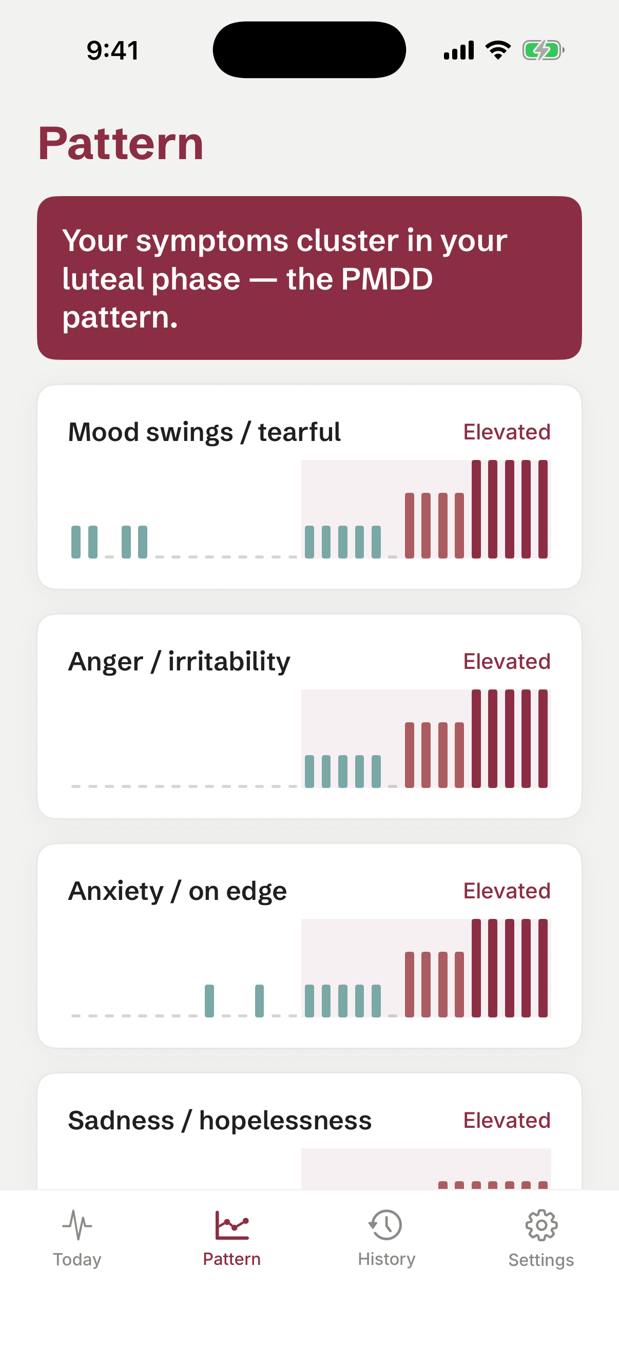
Prova is a PMDD symptom tracker for iPhone. Daily logging and the pattern view are free. Prova does not diagnose PMDD.
Print a daily PMDD symptom tracker or get Prova for iPhone on the App Store.
What about PMDD treatment and hormone therapy?
Freeman's review (2002) discusses estrogen studies for depression during perimenopause.[2] It describes mixed findings and says positive results still needed confirmation and study of long-term effects. Those depression findings do not establish that standard menopause hormone therapy treats PMDD.
The same review reports that progesterone did not improve PMS mood and behaviour symptoms more than placebo in the trials it describes.[2] That challenges the idea that simply adding progesterone reliably fixes premenstrual mood symptoms. The review is old; it is not a current prescribing guide.
Talk with your prescriber about what fits your symptom pattern. Describe what changed and what you want help with. Do not start, stop or change a medicine based on this page.
If you are thinking about suicide or are in crisis, call or text 988 (the US Suicide & Crisis Lifeline) right now.
Sources
- Sander BJ, Gordon JL, Brennand EA. Premenstrual dysphoric disorder. CMAJ, 2024. Clinical overview. https://pmc.ncbi.nlm.nih.gov/articles/PMC11627555/
- Freeman EW. Treatment of depression associated with the menstrual cycle: premenstrual dysphoria, postpartum depression, and the perimenopause. Dialogues in Clinical Neuroscience, 2002. Review. https://pmc.ncbi.nlm.nih.gov/articles/PMC3181677/
- Chung SH and colleagues. Premenstrual Syndrome and Premenstrual Dysphoric Disorder in Perimenopausal Women. Journal of Menopausal Medicine, 2014. Questionnaire survey. https://pmc.ncbi.nlm.nih.gov/articles/PMC4207004/