How is PMDD diagnosed?
PMDD is diagnosed from your symptom pattern, not from a test. A clinician wants to see daily ratings across at least two menstrual cycles, showing symptoms that build in the week before your period and fade soon after it starts.
Short answer: no blood test, scan or quiz can confirm PMDD. The standard route is a clinical history plus prospective daily symptom ratings (written down each day as you go, not recalled later) for two or more cycles, checked against the DSM-5 criteria.
What the DSM-5 criteria look for
The DSM-5 is the manual clinicians in the US use for mental health diagnoses. For PMDD it asks for all of these:
- Timing. Symptoms start in the final week before your period, get better within a few days of it starting, and are minimal or gone in the week after.
- At least five symptoms in total from the list below.
- At least one core mood symptom among them: marked mood swings, irritability or anger, depressed mood or hopelessness, or anxiety and tension.
- Real impact. The symptoms cause distress or get in the way of work, school, relationships or daily life.
- Not something else. They are not just a flare-up of another condition, and not caused by a medicine or substance.
- Confirmed by daily ratings across at least two symptomatic cycles.
The symptom list
| Group | Symptoms the criteria name |
|---|---|
| Core mood (need 1+) | Marked mood swings or sensitivity to rejection; irritability, anger or more conflict with others; depressed mood, hopelessness or self-critical thoughts; anxiety, tension or feeling keyed up |
| Other mood and thinking | Less interest in usual activities; trouble concentrating; feeling overwhelmed or out of control |
| Body and energy | Low energy or fatigue; changes in appetite, overeating or cravings; sleeping too much or too little; physical symptoms such as breast tenderness, bloating, joint or muscle pain |
Why two cycles of daily ratings, not one
Looking back, most of us remember the worst days and blur the rest. Writing a rating every day removes that guesswork. Two cycles show whether the pattern repeats, which a single month cannot.
The ratings also help rule out premenstrual exacerbation, where depression, anxiety or another ongoing condition gets worse before your period but never really clears. In PMDD there is a clear symptom-free stretch after your period starts. A written record is the clearest way to show that.
What happens at the appointment
- History. Expect questions about your cycle, your mood across the month, your family history, and any past depression, anxiety or other conditions.
- Other causes. A clinician may order blood work or an exam to check for thyroid problems, anemia or hormone conditions that can look similar. This rules things out. It does not confirm PMDD.
- Your daily ratings. This is the evidence that carries the most weight. Bring them, either on paper or exported from an app.
- Next steps. If the pattern fits, you can discuss treatment options with your clinician. If it does not, the same record helps them look for what else is going on.
If you are having thoughts of ending your life, do not wait for a diagnosis. In the US, call or text 988 (Suicide & Crisis Lifeline) right now. PMDD can bring sudden hopelessness in the days before a period, and it is a medical reason to ask for help, not a weakness.
How to track so it counts
- Rate every day, at the same time. A few seconds each evening is enough. Skipped days weaken the record.
- Rate severity, not just yes or no. A 1 out of 5 day and a 5 out of 5 day look very different on a chart.
- Mark the first day of your period each cycle, so symptoms can be lined up against cycle days.
- Note how much it got in the way. Impact on work, school and relationships is part of the criteria.
- Keep going through the good days. The quiet week after your period is half the evidence.
Prova does the lining-up for you
Prova is a PMDD symptom tracker. You rate the day in about ten seconds, covering the core mood symptoms and the others on the list above. Prova places each rating on your cycle, draws your severity curve, and shows whether your symptoms cluster in the luteal phase, the stretch before your period. Daily logging and the pattern view are free. A PDF report to bring to your appointment is part of Prova Pro.
Download Prova free →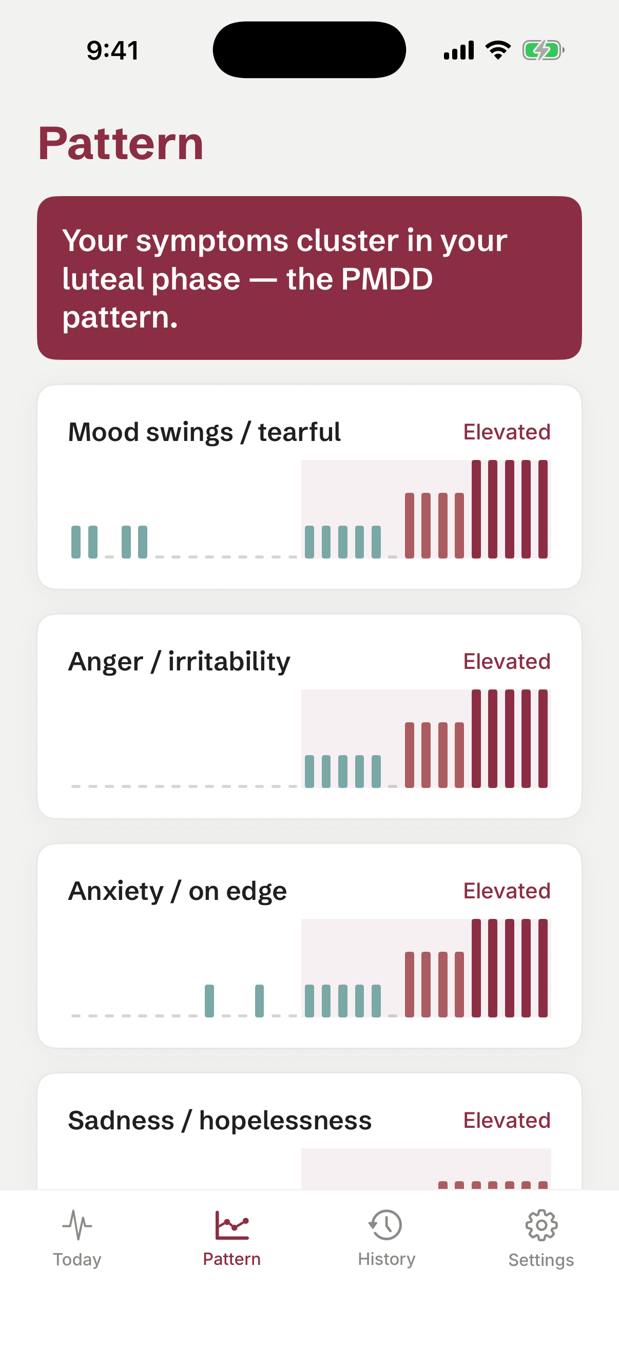
Questions people ask
Is there a blood test or scan for PMDD?
No. No blood test, scan or other lab test confirms PMDD. A clinician may order blood work to check for other causes, such as thyroid problems or anemia, but the PMDD diagnosis itself rests on your symptom pattern across your cycle.
How long does it take to get a PMDD diagnosis?
The tracking step alone takes at least two menstrual cycles, so roughly two months of daily ratings. Many clinicians will start talking about treatment sooner on a provisional basis, so do not wait to book the visit.
Can I be diagnosed with PMDD without tracking?
A clinician can suspect PMDD from your history alone. The DSM-5 asks for daily ratings across two symptomatic cycles to confirm it, mostly because it separates PMDD from other conditions that get worse before a period.
What is the difference between PMDD and premenstrual exacerbation?
In premenstrual exacerbation, an ongoing condition such as depression or anxiety gets worse before your period but never fully goes away. In PMDD, symptoms are mostly gone in the week after your period starts. Daily ratings are what show the difference.
Do I need a period tracker or a PMDD tracker?
Either can work if it records daily symptom severity against your cycle days. A plain period tracker that only logs bleeding will not show whether symptoms rise before your period and clear after it.
Does Prova diagnose PMDD?
No. Prova is a personal symptom record. It lines your daily ratings up with your cycle and shows whether symptoms cluster before your period, so you have something concrete to review with a qualified clinician.